
PEGASUS: Police Acquisition and Analysis of Heterogeneous Mass Data to Combat Organized Crime Structures
PEGASUS investigates how large and heterogeneous datasets can be structured, linked, and analyzed in a transparent and traceable manner. The subproject conducted by the University of Konstanz focuses on interactive visual analytics methods. These methods support domain experts in exploring complex relationships step by step, considering different perspectives, and critically reviewing analytical results.
The objective is not to develop an automated surveillance or decision-making system. Instead, the project investigates methods that enable transparent, context-aware, and human-centered analysis. To achieve this, data analysis, interactive visualizations, natural language processing techniques, and machine learning methods are combined. Legal, ethical, and qualitative requirements, including data protection, traceability, reproducibility, human oversight, and the mitigation of potential bias, are taken into account from the outset.
Research Questions
- Development of interactive analytical tools that enable domain experts to derive relevant relationships from large volumes of heterogeneous data, examine different hypotheses, and assess results in their respective context.
- Development of a visual analytics framework that combines data analysis, visualization, and interaction, enabling transparent navigation through complex datasets.
- Investigation of methods for analyzing textual content, metadata, temporal developments, and complex relationship and group structures.
- Investigation of the limitations and risks of data-driven analytical systems, particularly with regard to data protection, data quality, potential bias, misinterpretation, and discriminatory effects.
Selected Results
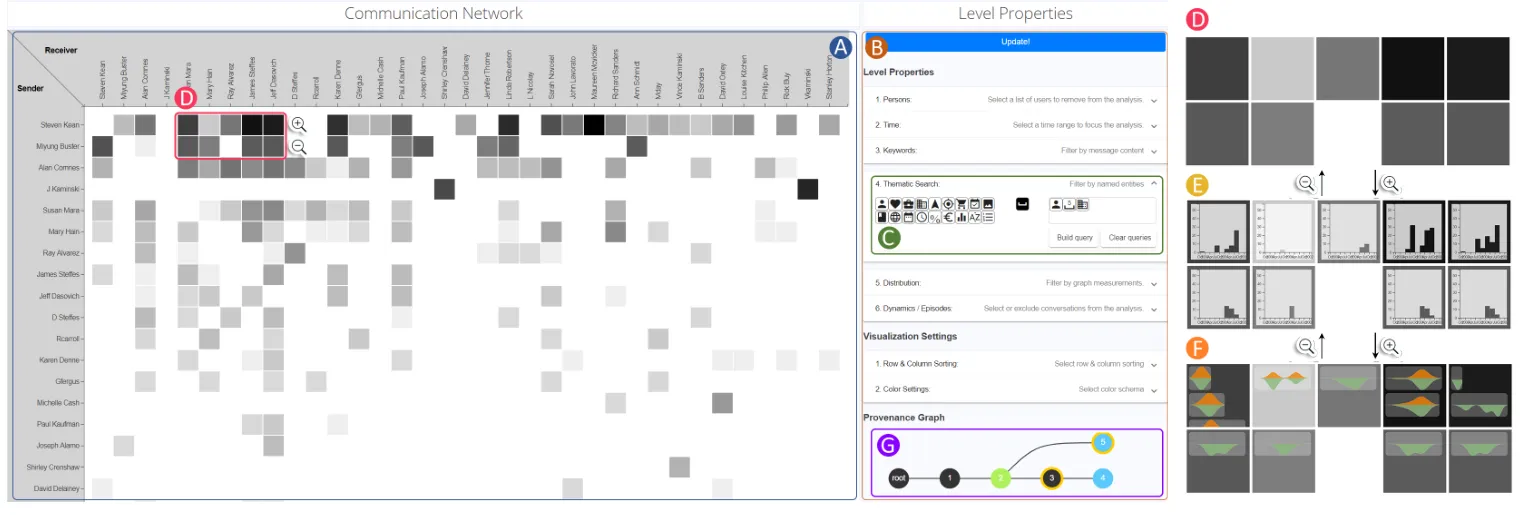
The University of Konstanz developed interactive visual analytics approaches for the transparent and traceable analysis of complex communication and relationship structures. These include methods for semantic text analysis, the visual exploration of temporal developments, and the representation of complex networks and group relationships.
A particular focus was placed on designing the analytical process in a transparent manner. The developed approaches enable domain experts to adjust search criteria, trace analytical steps, and critically review results. Responsibility for interpretation and assessment remains with the human user.
In addition, the subproject investigated ethical requirements for visual analytics systems in sensitive application domains. Particular attention was given to data protection, data quality, potential bias, and the risk of misleading conclusions. The results demonstrate how interactive and visual methods can help make data-driven analyses more verifiable, transparent, and responsible.
Funding

Federal Ministry of Education and Research
Federal Ministry of Education and Research (BMBF, Germany) in the project PEGASUS (project number 13N15268).