
ASGARD: Analysis System for GAthered Raw Data

ASGARD investigates how law enforcement agencies can use modern technologies responsibly, transparently, and independently of individual vendors. The project focuses on open-source solutions for the analysis of large and heterogeneous datasets, particularly in the areas of forensics and intelligence.
Our research group’s contribution focuses on interactive Visual Analytics methods. These support experts in systematically examining extensive communication data, identifying relevant patterns, and critically assessing analytical results.
The aim is not to develop an automated surveillance or decision-making system. The methods are designed to support the transparent and context-aware analysis of data that has already been collected. Human oversight, traceability, data protection, as well as ethical and societal requirements are taken into account throughout the process.
Research Questions
- How can large volumes of time-dependent communication data be analysed in a clear and transparent manner?
- How can relevant communication patterns and temporal changes be identified without reducing complex relationships to individual metrics?
- How can experts critically assess predictions generated by data-driven models and evaluate them in their specific context?
- How can visualisations, interactive analysis methods, and machine learning be combined in a way that actively incorporates human expertise into the analytical process?
- How do different projection techniques and parameters influence the representation of high-dimensional data?
Selected Results
Our research group’s contribution includes several interactive Visual Analytics techniques, models, and frameworks for the transparent analysis of time-dependent communication networks.
A novel technique supports experts in the analysis of timestamped, bidirectional interactions. Communication events are modelled as a continuous density function. This makes it possible to examine relevant episodes, temporal changes, and characteristic communication patterns in a targeted manner.
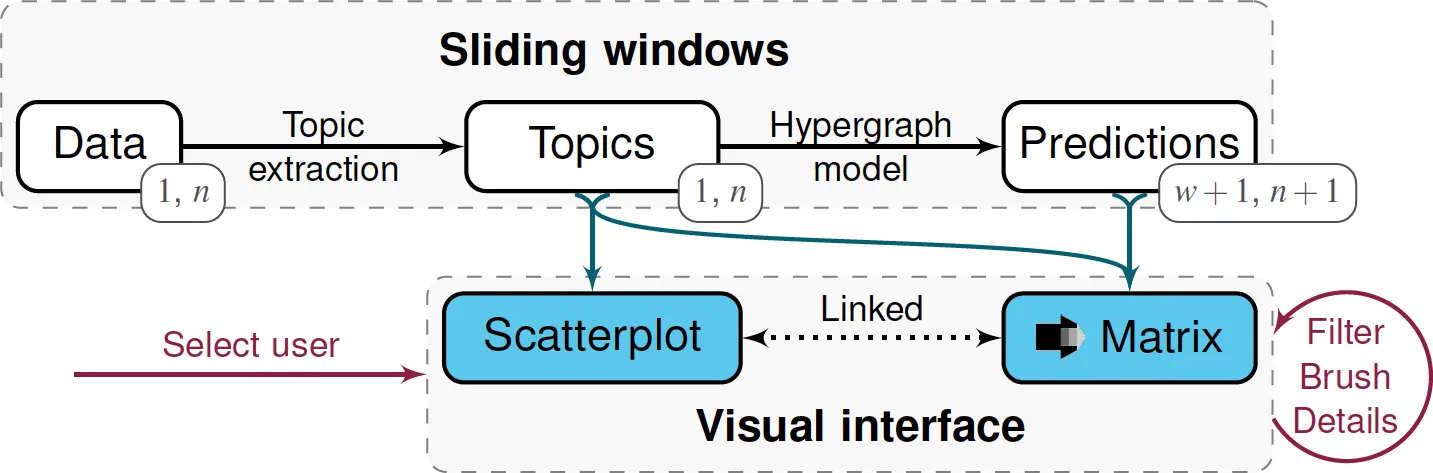
A Visual Analytics framework enables the assessment of temporal hypergraph prediction models. Using a sliding-window approach and interactive visualisations, experts can examine individual users in their respective context and compare predictions with training and test data. This makes the quality of the results transparent and open to critical evaluation.
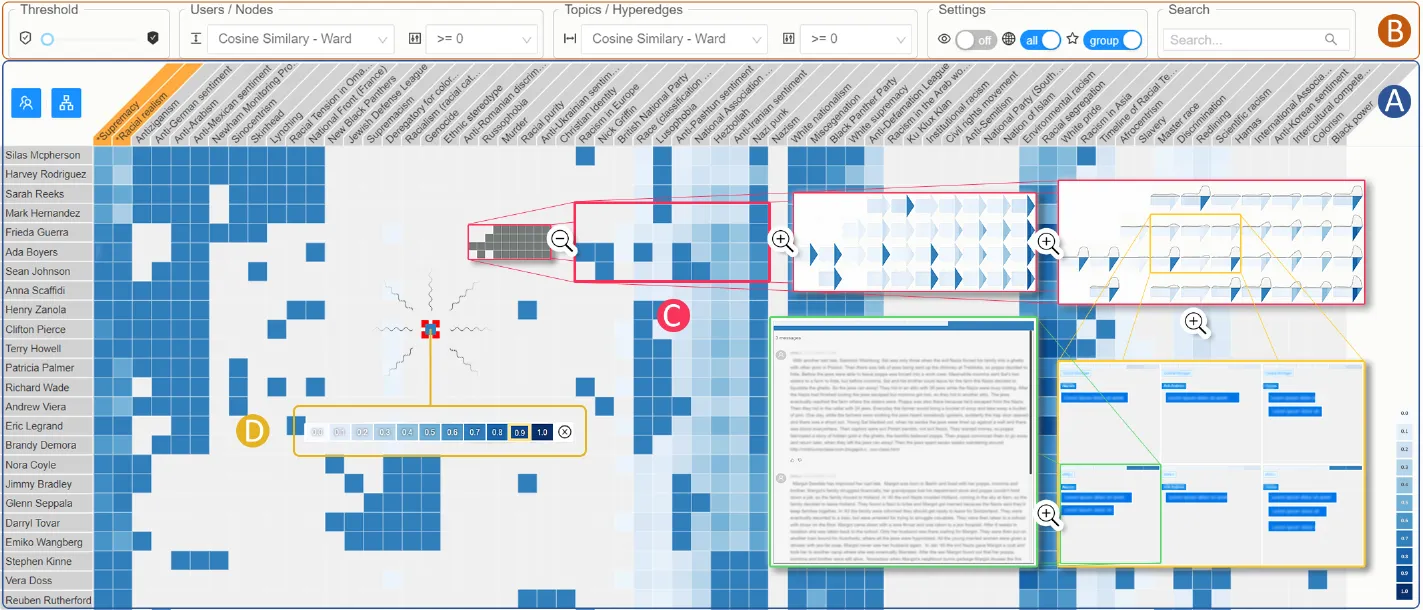
An interactive framework supports the exploration of temporal hypergraphs. A multi-level, matrix-based approach combines semantic zooming, filtering and search functions, dynamic partitioning, and interactive model feedback. This allows relevant connections and groups to be examined step by step while complementing data-driven models with human expertise.
The project also led to theoretical contributions to the analysis of high-dimensional data. In particular, the research examined how different projection techniques, features, and parameters influence the representation of complex datasets. The findings support the informed selection of suitable visualisation methods depending on the dataset and the analytical task.
Funding

European Union
This project has received funding from the European Union’s Horizon 2020 research and innovation programme under grant agreement No 700381.