

Bridging Data, Humans, and Artificial Intelligence
Visual analytics is an interdisciplinary research field that combines data analysis, visualization, and interactive techniques. Its goal is to help people derive relevant insights from complex datasets. By combining computational methods with human intuition, visual analytics transforms raw data into actionable knowledge. This approach is particularly effective for large, heterogeneous, and dynamic datasets. It enables users to identify hidden patterns, understand relationships, and make informed decisions. At the intersection of computer science and cognitive science, visual analytics provides tools that not only analyze complex information but also visualize and communicate it in an accessible way.
Human–AI Teaming in Visual Analytics
A central focus of visual analytics is human-AI teaming. This approach is particularly relevant when working with increasingly complex AI systems. Artificial intelligence can process large volumes of data efficiently, identify patterns, and perform repetitive tasks quickly and accurately. Humans, in contrast, contribute creativity, intuition, and contextual knowledge. Visual analytics provides a foundation for close collaboration between humans and AI by combining their complementary strengths. Through interactive visual interfaces, people can steer analytical processes while leveraging the computational power of AI to explore data more effectively. This enables more efficient and co-adaptive decision-making processes.
From Raw Data to Insight: The Visual Analytics Model by Keim et al.
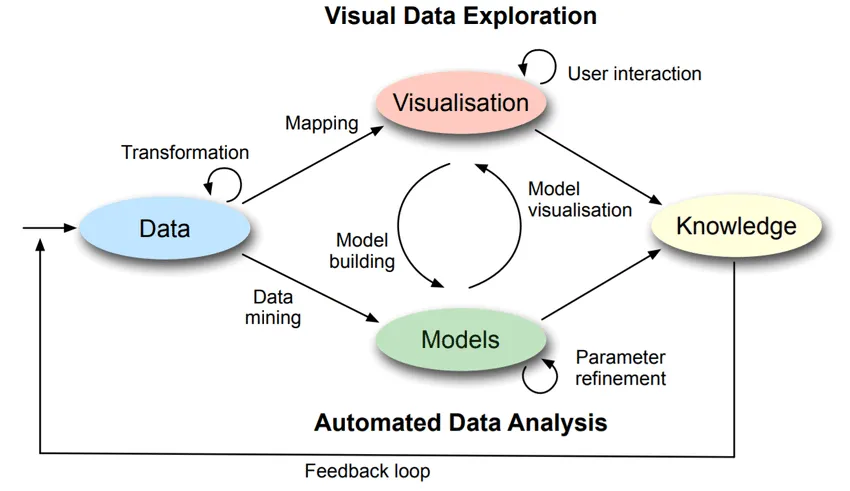
The Visual Analytics Model by Keim et al. provides a structured framework for this collaboration by integrating data preprocessing, visualization, hypothesis generation, and user interaction. Data is first preprocessed, transformed, and converted into suitable representations. Visual interfaces then allow users to explore the data intuitively, identify trends, and formulate hypotheses. Automated analyses supported by AI complement this process by validating insights or revealing anomalies. The iterative interaction cycle ensures that humans remain central to the process in the sense of a “human-in-the-loop” approach: visualizations are used not only to present results but also to refine questions and guide subsequent analytical steps.
As one of the founding groups in the field of visual analytics, our chair is particularly interested in expanding the role of visual analytics in human-AI collaboration. By developing tailored visual and interactive AI systems as well as suitable interfaces, we enable humans and AI systems to learn from one another through cooperative learning and guidance processes. This approach not only strengthens the decision-making capabilities of both actors but also promotes trust, understanding, and a shared framework for solving complex problems. Our research applies these principles to domains such as public safety and civil security, digital humanities and linguistics, sports and behavioral analytics, and geo- and infrastructure analysis. In this way, we continuously expand the potential of human-AI teams to address real-world challenges.